


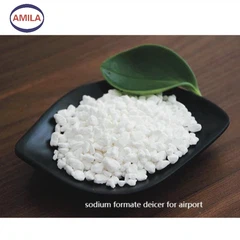

Industrial Grade Calcium Formate
Industrial Grade calcium formate
Product Features
High purity
Industrial grade calcium formate uses 99% pure reaction grade raw materials, ensuring the content is 98%±0.5%, with few impurities, which does not affect the performance of the end product.
Strong moisture resistance
The surface of calcium formate particles is spray dried, and the powder is not easy to absorb moisture and agglomerate. There is no obvious agglomeration when stored for 6 months without opening.
Easy to dissolve and mix quickly
The product has good solubility in water, is completely dispersed in concrete within 60 seconds, can react quickly with cement, and reduce mixing time.
Wide range of applications
Industrial grade calcium formate is widely used in dry mortar, concrete admixture, leather tanning agent, feed mildew inhibitor, etc.

1. Main raw materials and reaction principle:
Main raw materials:
1) Formic acid (HCOOH): It is strongly acidic and can react with alkali to form salt.
2) Calcium carbonate (CaCO3) or calcium hydroxide (Ca(OH)2): It is alkaline and reacts with formic acid to form calcium formate.
Reaction principle:
Formic acid can directly react with calcium carbonate to form calcium formate by taking advantage of its stronger acidity than carbonic acid. The reaction formula is: CaCO3+2HCOOH=Ca(HCOO)2+CO2↑+H2O.
Formic acid reacts with calcium hydroxide to form calcium formate and water. The reaction equation is: Ca(OH)2 + 2HCOOH = Ca(HCOO)2 + 2H2O
2. Production process
1) Raw material preparation
High-purity formic acid and calcium carbonate or calcium hydroxide are selected as raw materials to ensure product quality.
2) Reaction steps
Add calcium carbonate or calcium hydroxide to the reaction tank, and then add formic acid to react.
During the reaction process, it is necessary to control process parameters such as temperature and stirring speed to ensure that the reaction is fully carried out.
After the reaction is completed, filter the reaction solution to remove insoluble matter.
3) Concentration and crystallization
Concentrate the filtered reaction solution to remove excess water.
During the concentration process, calcium formate will gradually crystallize and precipitate.
4) Centrifugal separation
Separate the crystallized calcium formate with a centrifuge to obtain wet material.
5) Drying and packaging
Dry the wet material to remove moisture and obtain a solid calcium formate product.
The dried calcium formate product is packaged for storage and transportation.
3. Other production processes
In addition to the above traditional production processes, there are other methods for producing calcium formate:

1) Double decomposition of sodium formate and calcium nitrate
Under the action of a catalyst, sodium formate and calcium nitrate undergo double decomposition to produce calcium formate and sodium nitrate.
This method is suitable for the production of industrial-grade calcium formate.
2) Utilization of by-product formic acid
In the production process of certain chemicals, a large amount of by-product formic acid is produced.
These formic acid by-products can be used as raw materials to react with alkaline substances such as calcium hydroxide to produce industrial-grade calcium formate.
Hot Tags: industrial grade calcium formate, China industrial grade calcium formate manufacturers, suppliers, factory, calcium formate testing, additive for detergents calcium formate, soundproofing additives, Construction Grade Calcium Formate, non toxic calcium formate, calcium formate procurement
You Might Also Like


Send Inquiry