


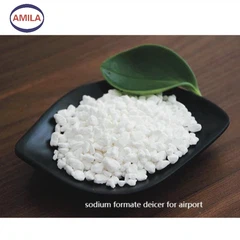
How does sodium formate react with organic solvents?
Nov 10, 2025
Leave a message
Sodium formate (HCOONa) is a versatile chemical compound that has found wide - ranging applications in various industries, including oil drilling, leather tanning, and as a reducing agent in chemical synthesis. As a trusted sodium formate supplier, I am often asked about how sodium formate reacts with organic solvents. In this blog post, I will delve into the chemical reactions and interactions between sodium formate and different organic solvents, exploring the underlying principles and potential applications.
Solubility and Basic Interactions
Before discussing the reactions, it's important to understand the solubility of sodium formate in organic solvents. Sodium formate is an ionic compound, and its solubility in organic solvents is generally low compared to its solubility in water. This is because organic solvents are typically non - polar or have low polarity, while sodium formate is highly polar due to the presence of ionic bonds.
However, some polar organic solvents can dissolve sodium formate to a certain extent. For example, solvents like methanol and ethanol have a polar hydroxyl group (-OH), which allows them to interact with the sodium and formate ions through dipole - ion interactions. In methanol, sodium formate can dissolve moderately, and the solubility increases with temperature. The dissolution process involves the separation of the sodium and formate ions from the crystal lattice by the solvent molecules. The oxygen atom in the hydroxyl group of methanol has a partial negative charge and can interact with the positively charged sodium ion, while the hydrogen atom with a partial positive charge can interact with the negatively charged formate ion.
Chemical Reactions with Organic Solvents
Esterification Reactions
One of the significant reactions of sodium formate with organic solvents occurs in the presence of alcohols under acidic conditions. When sodium formate reacts with an alcohol (R - OH) in the presence of a strong acid catalyst such as sulfuric acid, an esterification reaction takes place. The general reaction can be represented as follows:
[HCOONa+R - OH + H^{+}\rightarrow HCOOR+NaOH]
In this reaction, the formate ion from sodium formate reacts with the alcohol to form an ester (R - O - CHO). For example, if the alcohol is ethanol ((C_{2}H_{5}OH)), the product will be ethyl formate ((C_{2}H_{5}OCHO)). This reaction is widely used in the synthesis of esters, which have applications in the fragrance and flavor industry. Ethyl formate, for instance, has a pleasant fruity odor and is used as a flavoring agent.
The mechanism of this reaction involves the protonation of the formate ion by the acid catalyst, which makes the carbonyl carbon more electrophilic. The alcohol then attacks the electrophilic carbonyl carbon, followed by the elimination of water and the formation of the ester.
Reactions with Carbonyl - Containing Solvents
Sodium formate can also react with carbonyl - containing organic solvents such as aldehydes and ketones. In the presence of a base, sodium formate can act as a reducing agent. For example, when reacting with an aldehyde (R - CHO), sodium formate can reduce the aldehyde to the corresponding alcohol ((R - CH_{2}OH)). The reaction can be written as:
[2R - CHO+HCOONa + H_{2}O\rightarrow 2R - CH_{2}OH+NaHCO_{3}]
The formate ion donates a hydride ion ((H^{-})) to the carbonyl carbon of the aldehyde, which is then protonated by water to form the alcohol. This reaction is useful in the synthesis of alcohols from aldehydes, especially in cases where mild reducing conditions are required.
Reactions with Halogenated Organic Solvents
Sodium formate can react with some halogenated organic solvents. For example, with alkyl halides (R - X, where X is a halogen such as Cl, Br, or I), a substitution reaction can occur. The formate ion can replace the halogen atom in the alkyl halide, forming an alkyl formate (R - O - CHO). The reaction can be represented as:


[R - X+HCOONa\rightarrow R - O - CHO+NaX]
This reaction is a nucleophilic substitution reaction, where the formate ion acts as a nucleophile and attacks the electrophilic carbon atom attached to the halogen. The reaction rate depends on the nature of the halogen and the structure of the alkyl group. For example, primary alkyl halides react faster than secondary or tertiary alkyl halides due to less steric hindrance.
Applications in Different Industries
Oil Drilling Industry
In the oil drilling industry, sodium formate is used as a drilling fluid additive. Our Sodium Formate 98% Min and Sodium Formate for Oildrilling products are well - known for their excellent performance. When mixed with organic solvents in the drilling fluid, sodium formate can help to control the density and viscosity of the fluid. It can also interact with some organic additives in the drilling fluid, enhancing the overall stability of the fluid. For example, it can react with certain esters in the fluid to form new compounds that improve the lubricity of the drilling fluid, reducing the friction between the drill bit and the rock formation.
Chemical Synthesis
As mentioned earlier, the reactions of sodium formate with organic solvents are crucial in chemical synthesis. The esterification reactions are used to produce a wide range of esters, which are important intermediates in the production of pharmaceuticals, plastics, and other chemicals. The reduction reactions with aldehydes and ketones are also valuable in the synthesis of alcohols, which are used in the production of detergents, solvents, and other industrial products.
Leather Tanning Industry
In the leather tanning industry, sodium formate can be used in combination with organic solvents. It can react with some organic tanning agents to improve the tanning process. For example, it can react with certain aldehyde - based tanning agents to reduce their reactivity and make the tanning process more controllable. This results in better - quality leather with improved properties such as softness and durability.
Our Sodium Formate Products
We are a leading supplier of sodium formate, offering high - quality products such as Sodium Formate 98% Min, Sodium Formate for Oildrilling, and Liquid Sodium Formate. Our products are produced using advanced manufacturing processes and strict quality control measures to ensure their purity and performance.
Whether you are in the oil drilling, chemical synthesis, or leather tanning industry, our sodium formate products can meet your specific requirements. If you are interested in purchasing sodium formate or have any questions about its reactions with organic solvents, please feel free to contact us for further discussion. We are committed to providing you with the best products and services.
Conclusion
The reactions of sodium formate with organic solvents are diverse and have important applications in various industries. From esterification reactions to reduction reactions and substitution reactions, sodium formate can interact with different types of organic solvents to produce valuable compounds. As a sodium formate supplier, we are dedicated to providing high - quality products and supporting our customers in understanding the chemical properties and applications of sodium formate. If you are looking for a reliable source of sodium formate, we invite you to contact us for procurement discussions.
References
- March, J. (1992). Advanced Organic Chemistry: Reactions, Mechanisms, and Structure. John Wiley & Sons.
- Vogel, A. I. (1989). Vogel's Textbook of Practical Organic Chemistry. Pearson Education.
- Kirk - Othmer Encyclopedia of Chemical Technology. (2005). John Wiley & Sons.
Send Inquiry