


How does solid potassium formate affect the freezing point of a solution?
Jan 06, 2026
Leave a message
Hey there! As a supplier of Solid Potassium Formate, I've got a lot to share with you about how this nifty chemical affects the freezing point of a solution.
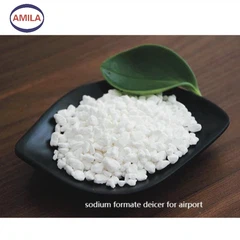
Let's start with the basics. Solid potassium formate is a white, crystalline salt with some pretty cool properties. It's highly soluble in water, which is a key factor when it comes to its impact on freezing points. When you add it to a solution, it starts to break down into its ions - potassium ions (K⁺) and formate ions (HCOO⁻).
Now, the science behind the freezing point depression is all about the colligative properties of solutions. Colligative properties depend on the number of solute particles in a solution, rather than the type of particles. When we dissolve solid potassium formate in a solvent like water, we're increasing the number of solute particles in that solution.
The solvent molecules in a pure liquid are arranged in a way that allows them to form a regular lattice structure when they freeze. But when we introduce solute particles, like those from potassium formate, they get in the way of this lattice formation. The solvent molecules have to work harder to arrange themselves into a solid structure, which means the temperature has to be lower for the solution to freeze.


For example, let's say you have a simple water solution. Water freezes at 0°C under normal atmospheric pressure. But if you start adding solid potassium formate to it, the freezing point will start to drop. The more potassium formate you add, the lower the freezing point goes. This is known as the freezing point depression.
The amount by which the freezing point is depressed is proportional to the molality of the solution. Molality is a measure of the number of moles of solute per kilogram of solvent. In the case of solid potassium formate in water, as we increase the molality of the potassium formate solution, we see a linear decrease in the freezing point.
Mathematically, the freezing point depression (∆Tf) can be calculated using the formula ∆Tf = Kf × m × i, where Kf is the cryoscopic constant of the solvent (for water, Kf = 1.86 °C/m), m is the molality of the solution, and i is the van't Hoff factor. The van't Hoff factor represents the number of particles into which the solute dissociates. For solid potassium formate, which dissociates into two ions (K⁺ and HCOO⁻), i = 2.
So, how does this all translate into real - world applications? Well, one of the big areas where the freezing point depression property of solid potassium formate is used is in oil drilling. That's where our Potassium Formate for Oildrilling comes in handy.
In oil drilling, the drilling fluid is crucial. It helps lubricate the drill bit, carry the cuttings to the surface, and maintain pressure in the wellbore. In cold environments, the drilling fluid needs to stay in a liquid state to function properly. By adding solid potassium formate to the drilling fluid, we can lower its freezing point, ensuring that it doesn't freeze even in extremely cold conditions. This helps prevent costly downtime and equipment damage.
Another application is in the carbon black industry. Potassium Formate for Carbon Black is used as a dispersant and anti - freezing agent. In carbon black production, solutions often need to be transported and stored at various temperatures. The addition of solid potassium formate helps keep these solutions from freezing, ensuring a smooth production process.
When it comes to using solid potassium formate to control the freezing point of a solution, there are some things to keep in mind. First, the solubility of solid potassium formate in water is quite high, but it still has its limits. As you add more potassium formate, you'll eventually reach a saturation point. Beyond this point, adding more won't have any additional effect on the freezing point because the excess won't dissolve.
Also, the quality of the solid potassium formate matters. Impurities in the product can affect its solubility and its ability to depress the freezing point. That's why it's important to source your solid potassium formate from a reliable supplier. And that's where I come in!
As a leading supplier of solid potassium formate, we ensure that our products are of the highest quality. We have strict quality control measures in place to make sure that our potassium formate is pure and free from contaminants. This guarantees that you'll get the best results when using it to lower the freezing point of your solutions.
If you're in the oil drilling or carbon black industry, or any industry where controlling the freezing point of a solution is important, I'd highly recommend considering our solid potassium formate. It's a cost - effective and efficient way to prevent solutions from freezing, saving you time and money in the long run.
So, if you're interested in purchasing solid potassium formate or want to learn more about its applications, don't hesitate to reach out. We're here to help you find the right solution for your specific needs. Whether you need a small quantity for testing or a large - scale supply for your production, we've got you covered.
In conclusion, solid potassium formate is a powerful tool for controlling the freezing point of solutions. Through the mechanism of freezing point depression, it offers practical benefits in various industries. So, if you're looking for a reliable and effective solution to keep your solutions from freezing, give our solid potassium formate a try.
References
- Atkins, P. W., & de Paula, J. (2014). Physical Chemistry. Oxford University Press.
- Chang, R. (2014). Chemistry. McGraw - Hill Education.
Send Inquiry