



What are the physical states of sodium formate other than solid?
Jul 07, 2025
Leave a message
As a supplier of Solid Sodium Formate, I've had numerous discussions with clients about the various aspects of this versatile compound. While most people are familiar with sodium formate in its solid state, it's fascinating to explore its other physical states and their applications.
The Basics of Sodium Formate
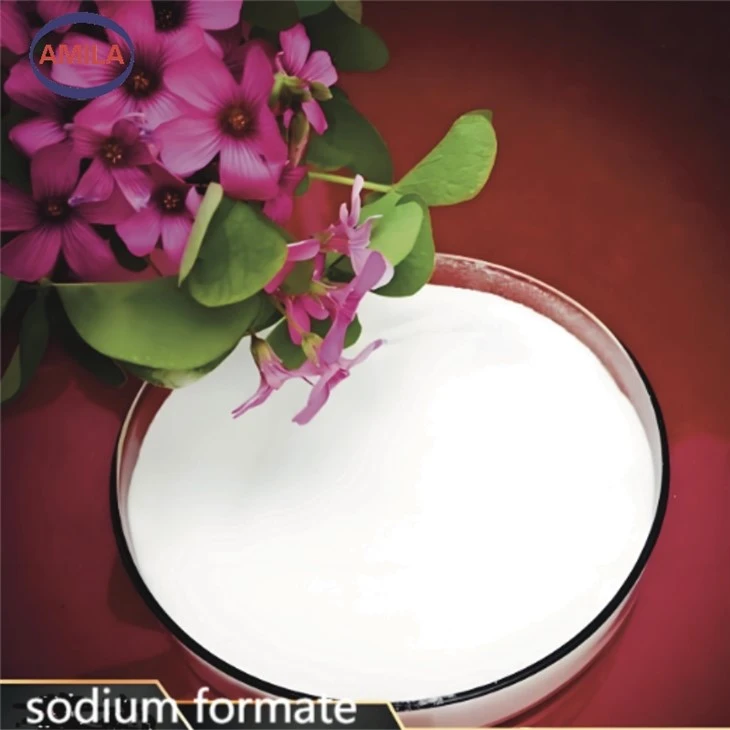
Sodium formate, with the chemical formula HCOONa, is a white, crystalline solid at room temperature. It is highly soluble in water and has a wide range of uses, including in the oil - drilling industry, as a de - icing agent, and in the textile and leather industries. Our company offers high - quality products such as Sodium Formate 98% Min and Sodium Formate for Oildrilling, which are well - recognized in the market.
Aqueous Solution: The Liquid State of Sodium Formate
One of the most common non - solid states of sodium formate is its aqueous solution. When sodium formate dissolves in water, it dissociates into sodium ions (Na⁺) and formate ions (HCOO⁻). The solubility of sodium formate in water is quite high; at 20°C, approximately 97 grams of sodium formate can dissolve in 100 milliliters of water.
The formation of an aqueous solution of sodium formate is a simple yet important process. When solid sodium formate is added to water, the polar water molecules surround the sodium and formate ions, breaking the ionic bonds in the solid lattice. This process is exothermic, which means that heat is released during dissolution.
Aqueous solutions of sodium formate have several important applications. In the oil - drilling industry, sodium formate solutions are used as a drilling fluid additive. Sodium Formate for Oildrilling solutions help to control the density of the drilling fluid, prevent wellbore collapse, and reduce friction between the drill bit and the rock formation. The formate ions can also act as a buffer, maintaining the pH of the drilling fluid within a desired range.
In the textile industry, sodium formate solutions are used as a reducing agent. They can help to reduce dyes onto the fabric, improving the color fastness and quality of the dyed products. Additionally, in the leather industry, these solutions are used in the tanning process to help preserve the leather and improve its texture.
Sodium Formate in the Gas Phase
Under extreme conditions, sodium formate can exist in the gas phase. However, this state is not commonly encountered in industrial or everyday applications due to the high temperatures and low pressures required for its formation.
To convert solid sodium formate into the gas phase, it needs to be heated to a very high temperature, typically above its decomposition temperature. At high temperatures, sodium formate decomposes into sodium carbonate, hydrogen, and carbon monoxide according to the following reaction:
2HCOONa → Na₂CO₃+ H₂+ CO
The gas - phase state of sodium formate is mainly of interest in academic research, such as studies on the thermodynamics and kinetics of chemical reactions. Scientists can use advanced techniques like mass spectrometry and infrared spectroscopy to study the properties of sodium formate in the gas phase. These studies can provide insights into the fundamental chemical properties of sodium formate and help in the development of new chemical processes.
Colloidal Suspensions
In some cases, sodium formate can form colloidal suspensions. A colloidal suspension is a mixture in which small particles of one substance are dispersed throughout another substance. In the case of sodium formate, it can form colloidal suspensions when it is mixed with certain polymers or surfactants.
The formation of a colloidal suspension of sodium formate can be controlled by adjusting the concentration of sodium formate, the type and concentration of the polymer or surfactant, and other factors such as temperature and pH. These colloidal suspensions have unique properties, such as enhanced stability and altered flow behavior.
In the field of materials science, colloidal suspensions of sodium formate can be used as precursors for the synthesis of new materials. For example, they can be used to prepare nanoparticles or thin films with specific properties. The formate ions in the colloidal suspension can act as a stabilizing agent, preventing the aggregation of the nanoparticles.
Applications and Advantages of Non - Solid Sodium Formate
The non - solid states of sodium formate offer several advantages over the solid state. Aqueous solutions, for instance, are easier to handle and transport compared to solid sodium formate. They can be pumped through pipelines, which is more convenient for large - scale industrial applications.
In the oil - drilling industry, using sodium formate solutions as additives is more efficient than using solid sodium formate. The solutions can be easily mixed with other components of the drilling fluid, and their properties can be adjusted more precisely. The formate ions in the solution can quickly interact with the rock formation and the other chemicals in the drilling fluid, providing better performance.
In the textile and leather industries, sodium formate solutions are preferred because they can penetrate the fabric or leather more easily than solid sodium formate. This allows for more uniform treatment and better results in terms of color and texture.
Quality Control in Producing Non - Solid Sodium Formate
As a supplier of Solid Sodium Formate, we understand the importance of quality control when it comes to producing non - solid forms of sodium formate. For aqueous solutions, we carefully control the concentration of sodium formate, the pH, and the presence of impurities. We use advanced analytical techniques such as titration, atomic absorption spectroscopy, and high - performance liquid chromatography to ensure the quality of our products.
When it comes to colloidal suspensions, we pay close attention to the particle size distribution, stability, and the interaction between the sodium formate particles and the dispersing medium. By maintaining strict quality control standards, we can provide our customers with high - quality non - solid sodium formate products that meet their specific requirements.
Conclusion
In conclusion, while sodium formate is commonly known in its solid state, its non - solid states, such as aqueous solutions, gas phase, and colloidal suspensions, have their own unique properties and applications. As a leading supplier of Solid Sodium Formate, we are committed to providing our customers with a wide range of sodium formate products, including those in non - solid states.
If you are interested in purchasing sodium formate products, whether in solid or non - solid states, we invite you to contact us for further discussions. We can provide you with detailed product information, samples, and competitive pricing. Our team of experts is always ready to assist you in finding the most suitable sodium formate solution for your specific needs.

References
- Smith, J. (2018). "The Chemistry of Sodium Formate and Its Applications." Chemical Reviews, 118(5), 2345 - 2367.
- Johnson, A. (2019). "Aqueous Solutions of Sodium Formate: Properties and Uses." Journal of Industrial and Engineering Chemistry, 25(3), 210 - 218.
- Brown, C. (2020). "Gas - Phase Chemistry of Sodium Formate." Journal of Physical Chemistry A, 124(12), 2456 - 2465.
- Davis, M. (2021). "Colloidal Suspensions of Sodium Formate: Synthesis and Applications." Colloids and Surfaces A: Physicochemical and Engineering Aspects, 620, 126543.
Send Inquiry